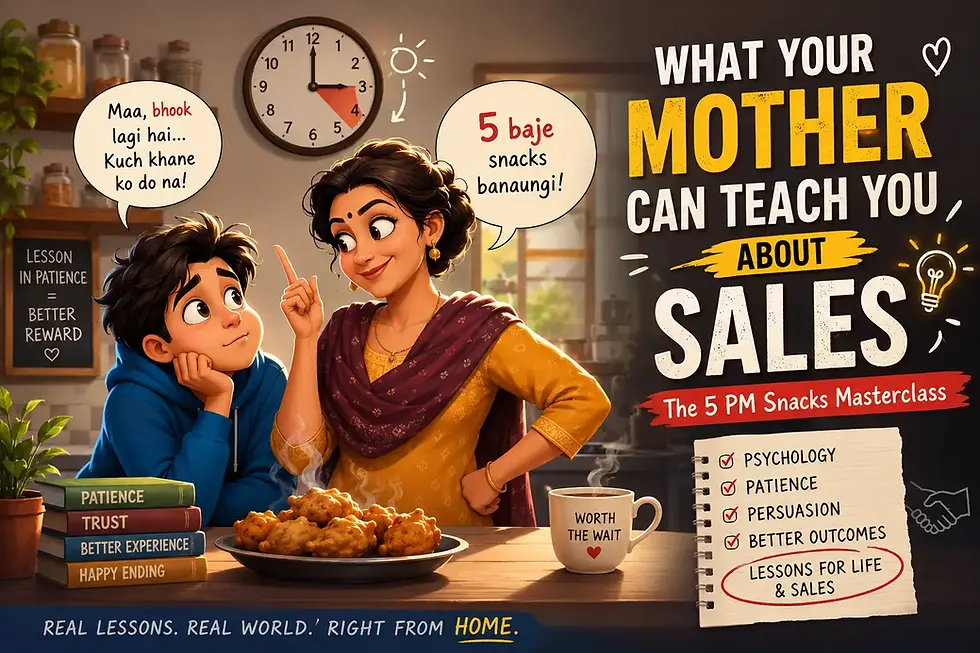
What Your Mother Can Teach You About Sales: The 5 PM Snacks Masterclass.
- Jul 4
- 4 min read

Maa, bhook lagi hai. Kuch khane ko do na..."
If you grew up in an Indian household, you've probably heard one of these replies:
"Abhi nahi."
"5 baje snacks banaungi."
"Thoda wait karo."
"Abhi kha loge toh dinner kaun khayega?"
Strange thing is...
You walked into the kitchen ready to argue.
Five minutes later, you quietly walked out.
At 5 PM, you happily enjoyed hot pakoras, sandwiches, poha, or cutlets as if waiting had been your own idea all along.
Congratulations.
You didn't just lose an argument.
You experienced one of the greatest sales conversations ever conducted inside an Indian home.
Most mothers have never attended a sales seminar, read books on consumer psychology, or learned negotiation techniques. Yet every day they convince the toughest customer in the house—their own child.
As sales professionals, there is an important lesson here.
Great selling is not about forcing a decision. It is about helping people become comfortable with a better one.
Let's decode how Indian mothers do it.
Lesson 1: She Never Rejects Your Request. She
Redirects It.
The biggest mistake many salespeople make is saying "No."
Customer:"I want a 15% discount."
Salesperson:"Sorry sir, that's not possible."
Conversation over.
Now look at your mother.
You:"Maa, kuch khane ko do."
Mother:"Abhi nahi."
Did she reject your request?
No.
She simply changed when your request would be fulfilled.
She replaced "No" with "Later."
Psychologically, this is much easier for the brain to accept because humans dislike rejection but can tolerate waiting if they believe something better is coming.
Sales Learning
Instead of saying:
"Sir, we cannot do that."
Say:
"Sir, let's do something even better."
or
"If we wait till Monday, I can help you with a better payment option."
The customer doesn't feel refused.
They feel guided.
Lesson 2: She Sells the Experience, Not the Food
Notice the language mothers use.
They don't say,
"I'll cook something."
They say,
"I'll make hot pakoras."
"I'll make your favourite sandwich."
"We'll all have tea together."
Suddenly your imagination starts working.
You can almost smell the pakoras.
You imagine the crispy bite.
The family sitting together.
Your brain has already started enjoying something that doesn't even exist yet.
This is called future visualization.
Great salespeople don't sell today's product.
They sell tomorrow's experience.
Sales Learning
Don't tell your customer,
"This apartment has a balcony."
Instead say,
"Imagine enjoying your evening tea on this balcony after a long day while your children play safely downstairs."
People buy emotions before they buy products.
Lesson 3: She Makes Waiting Feel Logical
After promising snacks at 5 PM comes the famous explanation.
"If you eat now, you'll spoil your dinner."
Simple sentence.
No complicated science.
Yet suddenly waiting feels reasonable.
Your mother hasn't changed your hunger.
She has changed how you think about it.
This is called reframing.
Instead of focusing on immediate satisfaction, she shifts your attention to the bigger outcome.
Sales Learning
Customers often focus on price.
Your job is to help them focus on value.
Instead of discussing cost, discuss ownership.
Instead of discussing EMI, discuss financial comfort.
Instead of discussing square feet, discuss quality of life.
Change the frame, and the decision changes.
Lesson 4: She Understands That Emotions Come Before Logic
Imagine coming home tired after school or work.
The first thing your mother usually asks is,
"What happened?"
"Tired lag rahe ho."
"Bhook lagi hai?"
She acknowledges your emotion before offering a solution.
That makes you feel understood.
Only then does she suggest waiting.
This sequence matters.
People rarely accept advice from someone who ignores their emotions.
Sales Learning
Never start with your presentation.
Start with understanding.
Ask questions.
Listen carefully.
Allow customers to explain their concerns.
People don't like being sold to.
They like being understood.
Lesson 5: She Gives You Hope
The magic sentence is always,
"Bas do ghante aur."
Notice something.
She gives you certainty.
Not someday.
Not later.
Exactly 5 PM.
The waiting now has an end point.
The human brain can tolerate delay when it knows the reward is certain.
Sales Learning
If your process takes time, never leave customers guessing.
Instead of saying,
"We'll get back to you."
Say,
"I'll call you tomorrow at 11 AM."
Certainty builds trust.
Uncertainty creates anxiety.
Lesson 6: Sometimes She Gives a Small Win
Many mothers quietly hand over a biscuit.
Or a banana.
Or a handful of roasted peanuts.
Not enough to replace snacks.
Just enough to reduce your impatience.
This is a classic psychological principle.
Small satisfaction reduces resistance.
Sales Learning
Before asking for a large commitment, offer something small.
A free consultation.
A project walkthrough.
A sample.
A trial.
A personalised report.
Small commitments make larger commitments easier.
Lesson 7: She Uses Trust Built Over Years
The strongest line in every Indian household is probably,
"Mujh par bharosa rakho."
You trust her because she has consistently made decisions that were in your best interest.
Trust removes the need for constant persuasion.
Sales works exactly the same way.
Customers don't buy from the person with the longest presentation.
They buy from the person they trust.
Trust is built through honesty, consistency, and keeping promises.
Why Mothers Are Such Effective Salespeople
They don't pressure.
They don't manipulate.
They don't chase.
They don't overwhelm you with information.
Instead, they naturally combine psychology with care.
Mother's Behaviour | Sales Psychology Behind It |
"5 baje banaungi." | Delay without rejection |
"Garam pakode banaungi." | Future visualisation |
"Dinner kharab ho jayega." | Reframing |
"Bas do ghante." | Certainty reduces anxiety |
Giving a biscuit | Small commitment |
Listening first | Emotional validation |
"Trust me." | Authority built through consistency |
Final Sales Lesson
Many salespeople believe convincing someone requires clever words, negotiation tricks, or endless follow-ups.
Indian mothers prove otherwise.
They convince us every single day without presentations, brochures, or discounts.
They understand that people don't resist decisions.
They resist feeling forced.
The moment someone feels respected, understood, and confident about the future, resistance starts disappearing.
The next time a customer says,
"I need to think."
or
"I'll decide later."
Remember your mother standing in the kitchen.
She never fought your hunger.
She redirected it.
She never argued.
She made waiting feel wiser.
And before you realised it, her idea had quietly become your decision.
That is not just parenting.
That is world-class selling.


Comments