What a Gift Reveals About Human Psychology: A Sales Lesson Hidden in Every Indian Family.
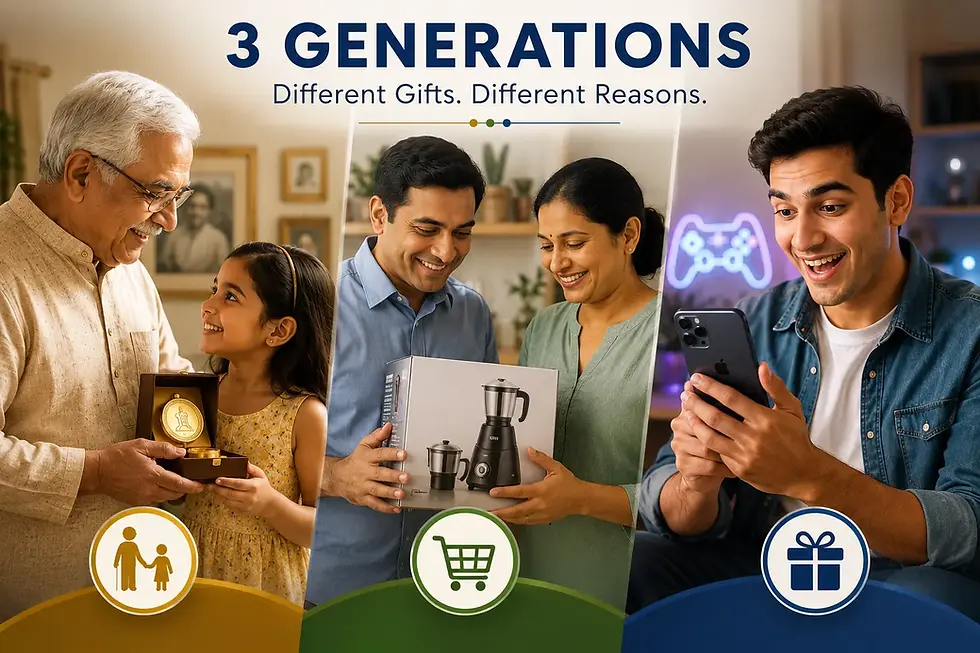
If you observe an Indian family carefully, you will notice something interesting.
A grandfather, a father, and a young adult may all buy gifts for the same person, but their reasons are completely different.
The grandfather often wants to be remembered.
The parent wants the gift to be useful.
The youngster wants the gift to create excitement and happiness right now.
Same action. Different psychology.
And that is one of the biggest lessons in sales.
People Buy for Their Reasons, Not Yours
Many salespeople focus too much on their product.
"This has great features."
"This is the latest model."
"This is the best option."
But customers rarely buy because of features.
They buy because of what the purchase means to them.
Understanding that meaning is where great sales begin.
Let's learn this from three generations of Indian buyers.
Grandparents: "I Want to Be Remembered"
Think about an Indian grandfather buying something for his grandchild.
He may buy a gold coin on a birthday.
He may contribute to an education fund.
He may gift a family heirloom.
Why?
Because the gift is not just a gift.
It is a memory.
It is a way of saying:
"When I'm not around, I want you to remember me."
The emotional value is often far greater than the monetary value.
Sales Lesson
Many customers buy products because they want to leave a legacy.
A businessman buying a premium office space may not be thinking about square feet.
He may be thinking:
"My children should remember that I built this."
A person buying life insurance may not be buying a policy.
He may be buying peace of mind for his family.
A buyer purchasing a plot of land may be imagining future generations benefiting from it.
The sale happens when you understand the legacy behind the purchase.
Parents: "I Want Something Practical"
Now look at Indian parents.
Ask a mother what she wants to gift her child.
Many times she will choose something useful.
A study table.
A laptop.
A water bottle.
A coaching course.
A school bag.
Not necessarily exciting. But practical.
Because parents often think long term.
Their love is expressed through usefulness.
When a father buys a vehicle, he may ask:
"Kitna mileage deti hai?"
When a mother buys a washing machine, she may ask:
"Maintenance kitna lagega?"
They are not trying to spoil the moment.
They are trying to make life easier.
Sales Lesson
Many customers are not looking for the cheapest product. They are looking for the safest decision.
The salesperson who keeps talking about luxury and excitement may completely miss what matters.
A parent buying an apartment may focus more on:
School nearby
Safety
Water supply
Connectivity
Maintenance costs
The emotional trigger is not excitement.
The emotional trigger is responsibility.
Understanding this changes the conversation completely.
Youngsters: "I Want Something That Feels Good Right Now"
Now look at young buyers.
A college student may spend money on:
The latest smartphone
Sneakers
Headphones
A bike upgrade
Concert tickets
Many purchases are driven by immediate satisfaction.
There is nothing wrong with it.
Youth is often associated with experiences, social status, fun, and self-expression.
The question is often not:
"Will this help me in ten years?"
The question is:
"Will this make me happy today?"
Sales Lesson
Some customers buy because they want to enjoy life.
Not every purchase needs a financial justification.
Not every customer wants a return on investment calculation.
Many want confidence.
Convenience.
Recognition.
Excitement.
Status.
Experience.
A salesperson who understands this can position the same product very differently.
A bike can be presented as:
Reliable transportation (for a parent)
A family asset (for a grandparent)
Freedom and excitement (for a youngster)
Same bike.
Different buyer.
Different story.

The Real Estate Example
Imagine selling a 3BHK apartment in India.
To a Grandparent
You might discuss:
A home where generations can gather
Creating family memories
Leaving an asset for children and grandchildren
To a Parent
You might discuss:
Good schools nearby
Safety
Future appreciation
Practical living
To a Young Professional
You might discuss:
Lifestyle
Modern amenities
Social circle
Convenience to work
The apartment hasn't changed.
The psychology has.
And psychology closes sales.
The Biggest Mistake Salespeople Make
Most salespeople assume everyone buys for the same reason.
They present the same brochure.
The same features.
The same pitch.
To everyone.
But customers are not buying products. They are buying outcomes.
A grandfather may buy to be remembered.
A parent may buy to be responsible.
A youngster may buy to enjoy the present.
The moment you discover which motivation is driving the customer, your conversation becomes meaningful.
Final Thought
The next time you attend a family function, observe the gifts being exchanged.
Don't look at the gift.
Look at the intention behind it.
You'll discover something powerful.
Human beings rarely buy what something is.
They buy what it means.
And sales is nothing more than understanding that meaning before anyone else does.
Because great salespeople don't sell products. They understand people.
Learn from our Curated Book Collection : https://amzn.to/4e2E1Uk


Comments