The Psychology of Feeling Like You Got a Better Deal : Lessons From Indian Mom
Why Moms Never Give Discounts but Always Make You Feel You Won

The Indian Mom School of Sales — A Lesson for Individual Sellers
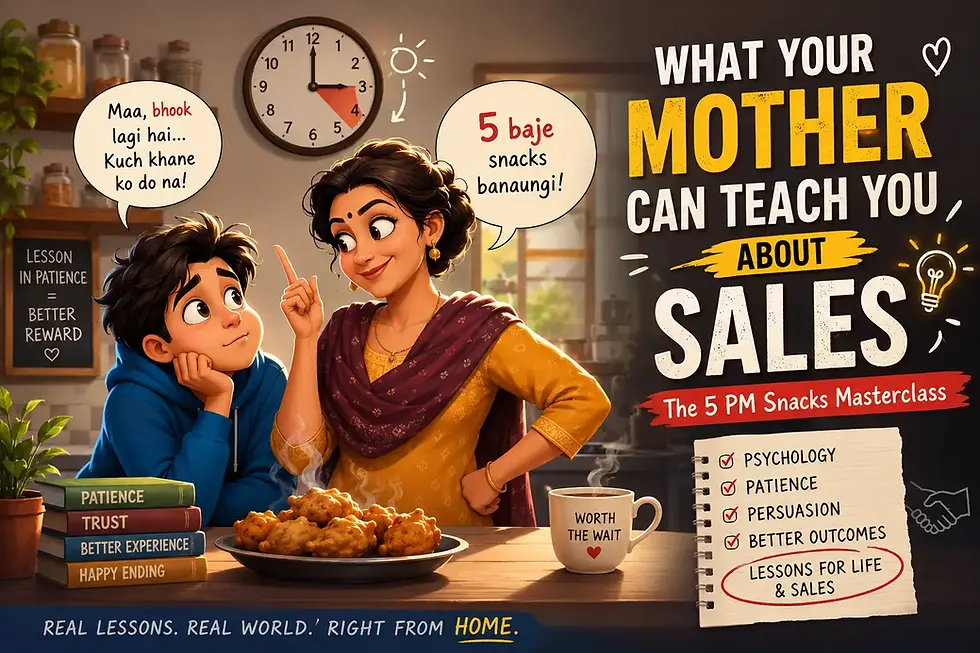
Ask any Indian kid for extra pocket money and watch what happens. Mom doesn't say yes. She doesn't say no either. She says, "Theek hai, lekin tumhare marks pehle improve karo" (fine, but improve your marks first) — and somehow, twenty minutes later, you're doing homework and feeling like you negotiated a win.
She never discounted anything. She never will. And yet you walk away feeling like you got a deal.
That, right there, is one of the most sophisticated closing techniques in the world — and it's been running in Indian households for generations, completely free of MBA jargon. This blog breaks down exactly how Indian moms do it, and how you, as an individual seller, can ethically borrow the same psychology to close more deals without ever cutting your price.
The Core Mom Principle: Value Exchange, Never Value Erosion
A discount says: "What I'm offering wasn't worth the original price." A mom's "deal" says: "You get something extra — but you earn it."
That one shift changes everything. Discounts train the buyer to distrust your price. Mom-style value exchange trains the buyer to feel proud of the outcome. She never lowers the price of anything — she raises the perceived value of the exchange.
Real-Life Mom Scenarios (And What They're Secretly Teaching You)
Scenario 1: The Pocket Money Negotiation Kid asks for ₹500. Mom says, "₹300, aur baaki tumhe kaam karke kamana padega" (₹300, and you'll have to earn the rest by helping around the house). Kid ends up doing chores, feels accomplished, and mom never actually "gave in."
Sales translation: Never drop your price. Offer an added-value path instead — a bonus, a faster timeline, a small extra service — that costs you little but feels earned to the buyer.
Scenario 2: The Sabzi Mandi Refusal-That-Isn't Mom haggles with the sabziwala. He won't drop the rate on tomatoes. Instead, he throws in a handful of free dhaniya (coriander) "just for you, aunty." Mom walks home feeling she won. The tomato price never moved an inch.
Sales translation: This is the oldest trick in Indian retail — and it works because the "bonus" feels personal, not transactional. A free add-on feels like a gift. A price cut feels like a loss for someone.
Scenario 3: "Papa Se Poochna Padega" (I'll Have to Ask Your Father) When a kid pushes too hard, mom doesn't cave — she introduces a delay and a second decision-maker, even if she'll decide anyway. This resets the emotional pressure and buys her time to hold her position.
Sales translation: When a buyer pushes hard for a discount, you don't have to say no immediately. "Let me check with my team/vendor and see what I can do" isn't weakness — it's a pause that lets both sides cool down and reset expectations, without you committing to anything on the spot.
Scenario 4: The "Best for You" Reframe Kid wants the expensive branded shoes. Mom picks the mid-range pair and says, "Yeh zyada tikau hai, tumhare liye better hai" (this one's more durable, better for you). The kid isn't told no — they're told this is better, and somehow leaves happy with a different, often cheaper, choice.
Sales translation: When a buyer wants something outside their budget or your best margin, don't argue against their choice — reframe toward the option that serves them best. People rarely resist being taken care of.
The Psychology Behind It: Why This Works Better Than Discounting
Discounts train buyers to wait for the next discount. Moms never train this habit — the "deal" changes every time, so kids never learn to expect a fixed pattern.
A feeling of "winning" creates loyalty; a feeling of "getting cheap stuff" creates price-shopping. Kids don't shop around for a better mom. Buyers who feel they "won" a negotiation rarely shop around either — they associate the win with you, not just the product.
Earned value feels more valuable than given value. A free discount feels like charity. A "deal you worked for" feels like an achievement — and people protect and justify their achievements, including to friends and family (read: referrals).
How to Use "Mom Tricks" to Close More Sales
1. Replace price cuts with value-adds. Instead of "I'll knock off ₹2,000," try "I can't move on price, but I'll include the onboarding session free — normally that's ₹2,000 on its own." Same cost to you, completely different psychological effect on the buyer.
2. Make the buyer "earn" the extra. "If you can confirm by Friday, I'll include the extended warranty at no cost." This isn't manipulation — it's a genuine mutual exchange: speed for value. The buyer feels they unlocked something, not that you folded.
3. Introduce a believable pause. "Let me see what's possible" or "let me check with my supplier" isn't stalling — it's giving both of you room. A too-quick yes to a discount request signals your original price was inflated. A short, honest pause preserves your price's credibility.
4. Reframe instead of refuse. When a buyer asks for something you can't give, don't just say no — offer the alternative that genuinely serves them better. "That plan won't get you what you actually need — let me show you the one that will."
5. Let the "win" be memorable, not the money. People remember how a negotiation felt, not the exact number. A buyer who feels smart, respected, and taken care of will talk about you. A buyer who just got 10% off will talk about the 10%.
Do's and Don'ts of the Mom Method
DO:
Give value-adds (bonuses, faster service, extra support) instead of straight discounts.
Let the buyer feel they influenced the outcome — even small concessions should feel like a joint win.
Use natural pauses ("let me check") to protect your pricing without saying a flat no.
Reframe pushback toward what's genuinely best for the buyer — sincerity is what makes this work, not manipulation.
DON'T:
Discount so often that buyers start negotiating harder every single time, expecting it as the norm.
Make the "win" feel fake or scripted — buyers, like kids, can smell a manufactured concession from a mile away.
Use guilt or pressure to close (that's a different, fear-based tactic — and it damages trust long-term).
Give away something that costs you real margin just to "feel generous." The bonus should be low-cost to you, high-value to them.
Common Problems and Fixes
Problem: "Buyers always ask for a discount, and I don't know how to say no without losing the deal." Fix: Don't say no to the ask — say no to the discount and yes to a value exchange. "I can't reduce the price, but here's what I can add" keeps the conversation moving forward instead of ending in a standoff.
Problem: "I've discounted before, and now every client expects it." Fix: You've trained the market the same way an over-permissive mom trains a kid to always ask twice. Break the pattern gradually — stop offering discounts and start offering bonuses instead. It takes a few cycles, but buyers adjust to the new normal quickly if the value story is consistent.
Problem: "My value-adds don't feel exciting enough to replace a discount." Fix: The mistake is pricing it in your head, not theirs. A free onboarding call might cost you 30 minutes, but if it saves the buyer hours of confusion, it's worth far more to them than a small price cut. Sell the outcome of the bonus, not the bonus itself.
Problem: "I feel like I'm 'tricking' buyers by not giving straight discounts." Fix: There's a difference between manipulation and psychology used honestly. A mom isn't lying when she offers dhaniya instead of a price cut — she's just choosing where the value flows. As long as what you're offering is real and genuinely useful, this isn't a trick — it's smart, respectful negotiation.
The Takeaway
Indian moms have been running masterclasses in negotiation at the dinner table for decades — no discounts, no losses, and yet everyone leaves the table feeling like they won something. The secret isn't a lower price. It's a better feeling about the price that's already fair.
The next time a buyer pushes for a discount, don't reach for your price list. Reach for your dhaniya — the small, sincere extra that makes them feel like they won, without you ever losing a rupee of value.


Comments